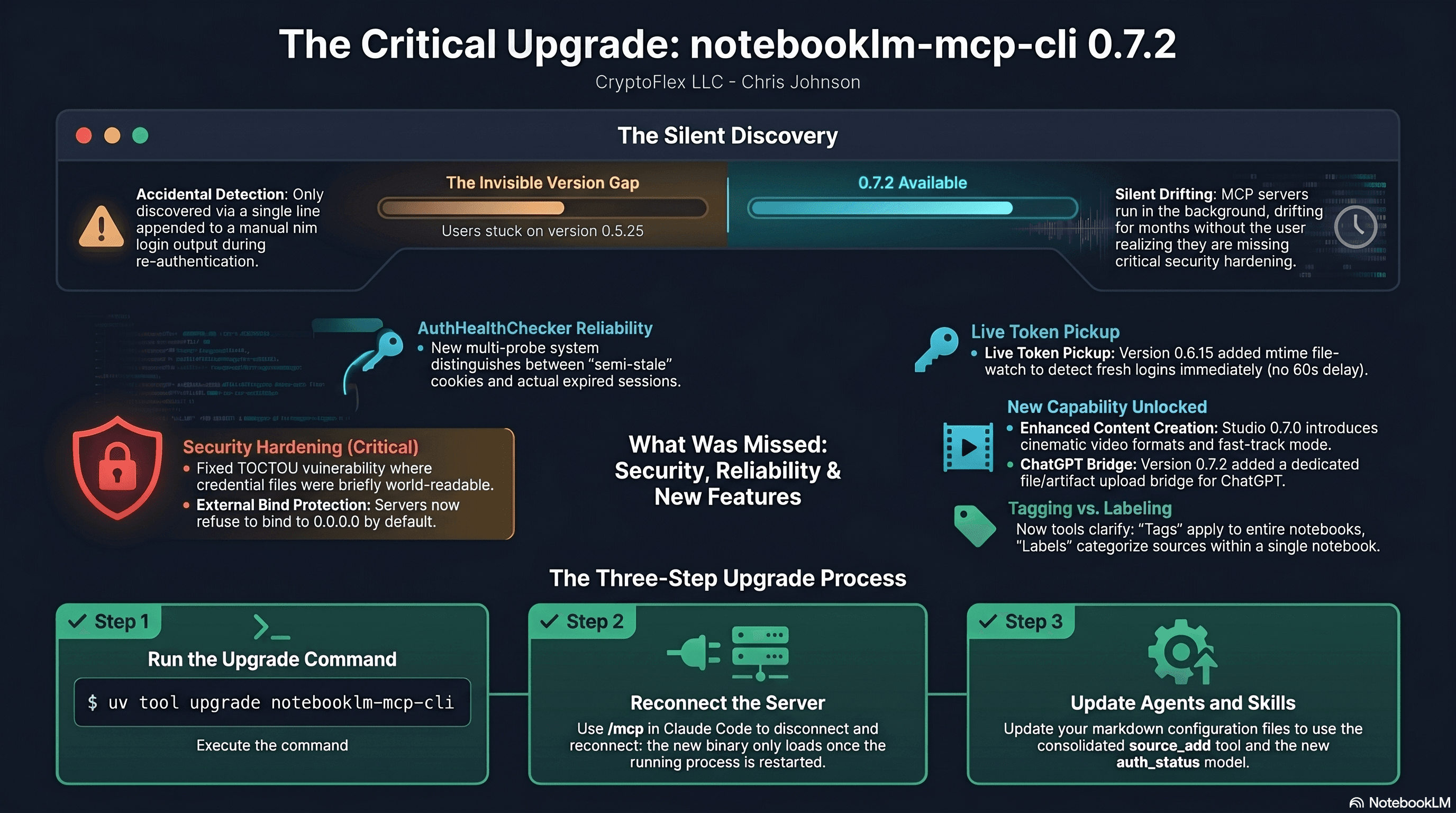
I was two minor versions behind on notebooklm-mcp-cli and had no idea until a re-auth banner interrupted a session. The gap was 0.5.25 to 0.7.2. Security fixes, auth reliability improvements, and new features I was missing the whole time. Here is the three-part upgrade that most people stop after step one.
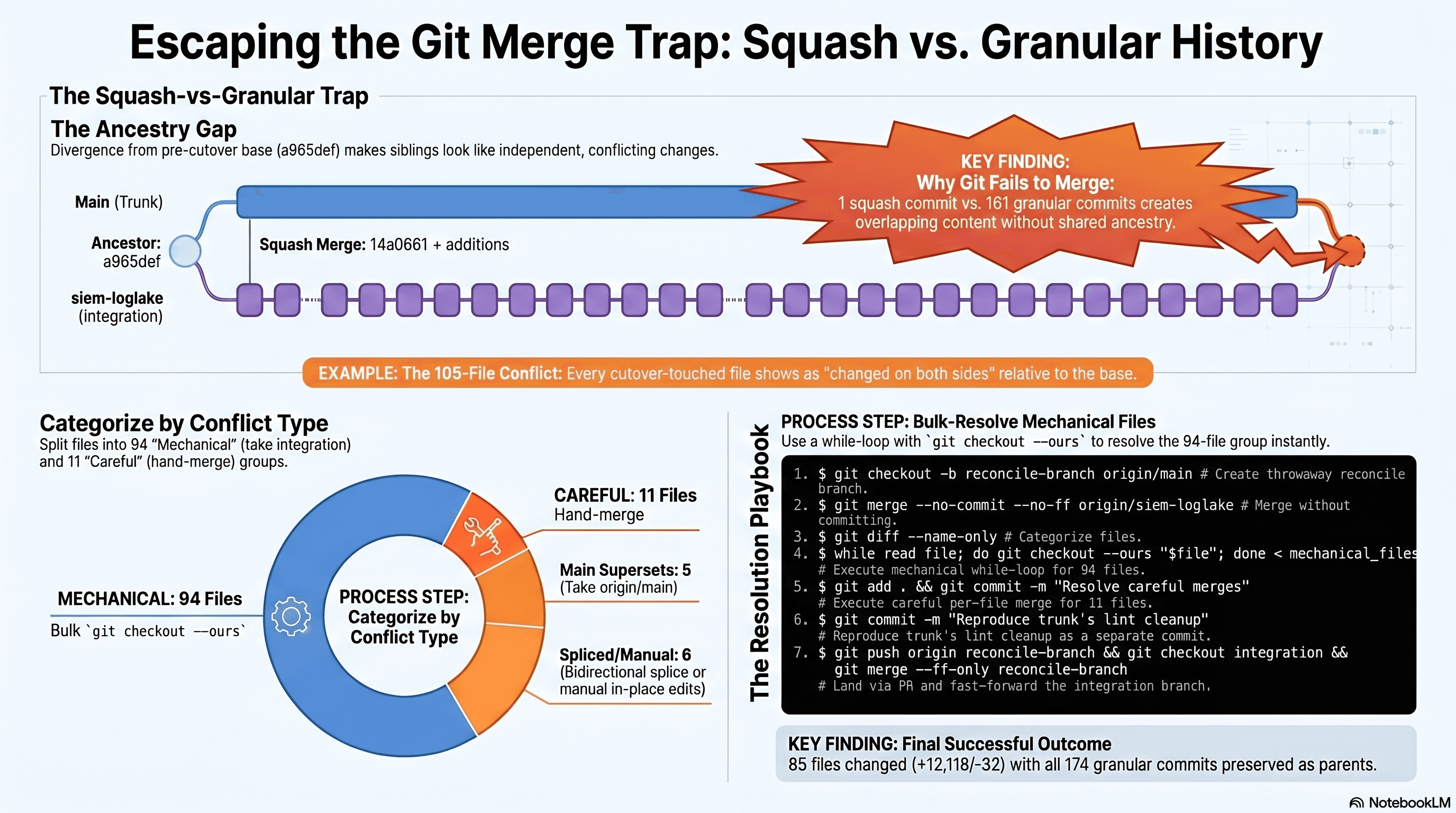
A long-lived integration branch went unmergeable two months after the trunk took its first big slice as a squash merge. Plain git merge spat 105 conflicted files. This post walks the playbook that landed it: how to spot the trap, how to categorize the conflicts, the exact commands that resolved 94 of them mechanically, and the three subtleties that bite you when you reach for `git checkout --ours`.
My Gmail assistant ran clean for two months, then quietly died for a full week before I noticed. The bridge daemon that drove it had pinned itself to a stale Claude CLI version, every scheduled fire failed within seconds, and no transcript was ever written. This post walks through why I migrated the agent off Claude Routines and onto the Claude Agent SDK, what the new stack looks like on launchd, and the parity gate that has to pass before the old agent gets decommissioned.
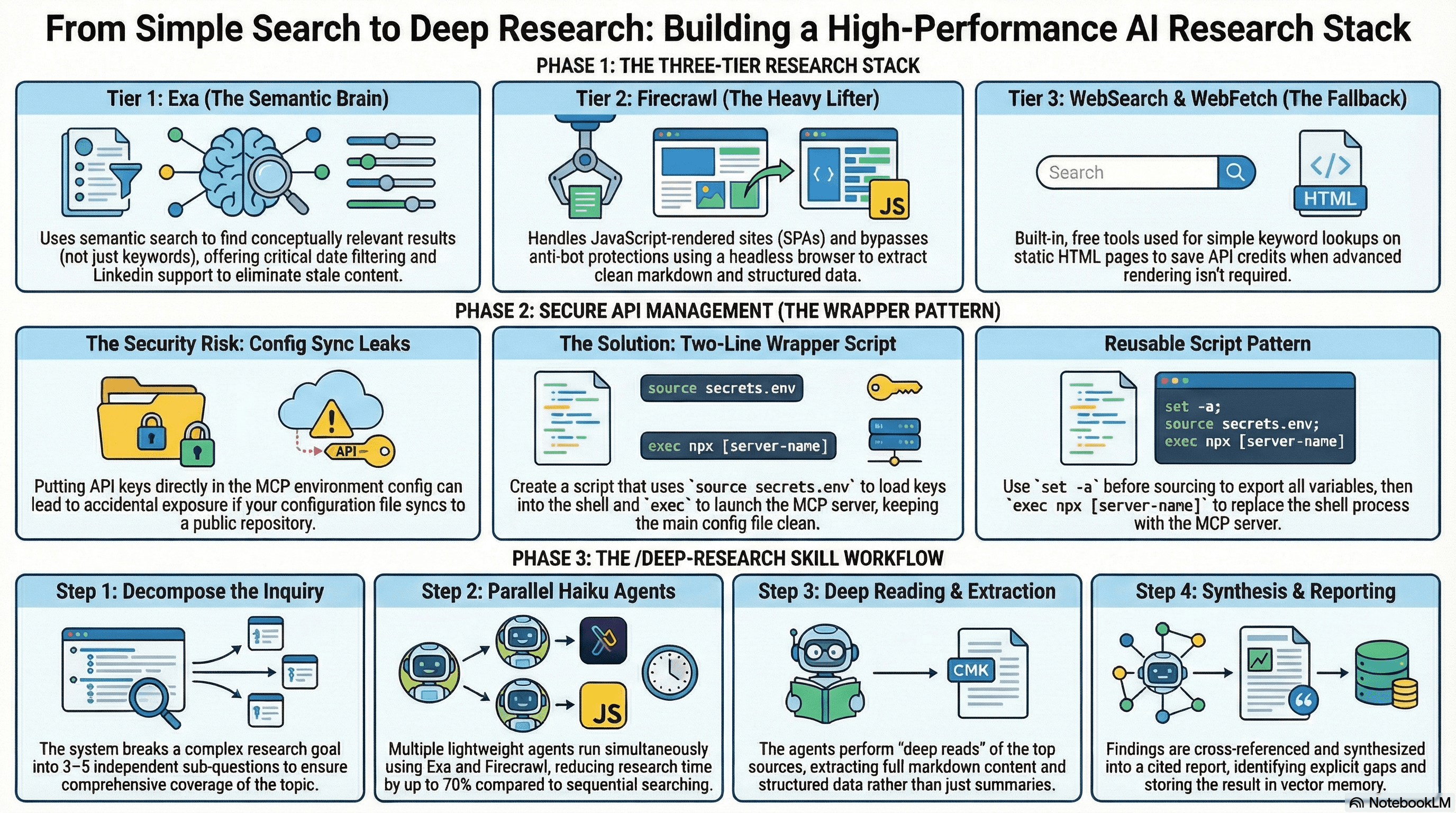
3 test sessions, 2 MCP servers, 1 wrapper script fix. How I added Exa and Firecrawl to Claude Code for semantic search, JS-rendered scraping, and proper deep research capability.
35 MCP tools, 7 implementation tasks, 2 platforms, 1 session. How I used the superpowers brainstorming, writing-plans, and subagent-driven-development pipeline to integrate NotebookLM into Claude Code as a first-class MCP server.
A beginner-friendly guide to the features that make Claude Code powerful: CLAUDE.md, directory structure, permissions, plan mode, checkpoints, skills, hooks, MCP, plugins, context, slash commands, compaction, agents, and rules. Everything you need to know to get started successfully.
I ran a routine audit on my Gmail agent and discovered the knowledge graph had been completely empty for months, the memory nudge hook had five blind spots, and nothing was catching either problem. Here's what I built to fix it.
I set up the Claude Code iMessage plugin as a proof of concept, debugged two real bugs, and discovered a fundamental security flaw that made me tear the whole thing down. Here's the full story.
Claude Code's /compact command frees up context but destroys in-progress session state. Smart-compact is a custom skill that saves everything before you compact, so you can pick up exactly where you left off.
Building a Gmail cleanup agent in Claude Code, evolving it from a manual 5-step script to a fully autonomous v3 with VIP detection, delta sync, auto-labeling, and follow-up tracking. Then making it run unattended every 5 hours via scheduled triggers and a remote-control daemon on a Mac Mini.
Three ways to run Claude Code remotely. I tried Dispatch, Channels, and Remote Control. Here's what broke, what worked, and why I landed on Remote Control with Warp terminal on my always-on Mac Mini.
How I replaced three separate Google Workspace MCP integrations with a single gws CLI skill, why CLI beats MCP for large API surfaces, and the four-tier safety system that keeps destructive operations from running without confirmation.
A practical walkthrough of the 5 Node.js MCP servers I run with Claude Code: sequential-thinking, memory, context7, github, and project-tools. What they do, how to configure them on Windows, and what I learned testing each one.
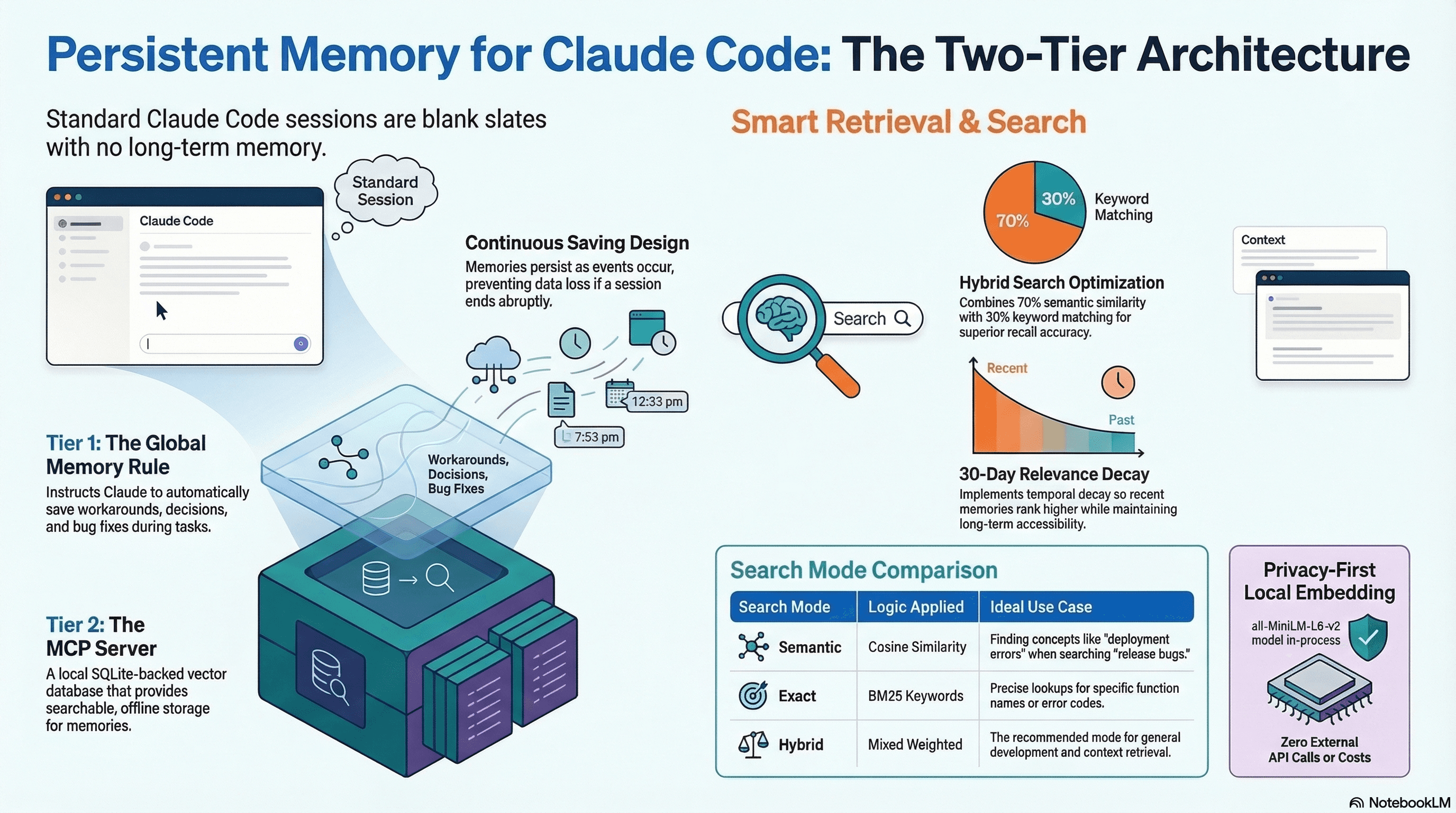
How to give Claude Code real persistent memory using a global rule file and a vector database MCP server, so context survives across sessions without any manual effort.
I reviewed an AI-generated recommendation to convert my custom agents into 'captains' that spawn parallel sub-agents. Here's what I learned about factual assessment, corrected parallel structures, sandbox constraints, and when to use this pattern (or keep it simple).
How I cataloged 13 custom agents, 23 learned skills, 10 rules, 8 bash scripts, and 2 MCP servers into a searchable, filterable showcase page for my blog. One session. One new route. One background research agent doing the heavy lifting.
What happens when you ship 90% context reduction in the morning and build a full backlog staging system by afternoon? A look at a typical day building with Claude Code.
From 70K tokens per session to 7K. A 7-agent audit, 23 evaluation documents, 11 component scorecards, 5 optimization patterns, and an 8-agent implementation team. This is the full story of cutting context consumption by 90%.
A 5-agent team chewed through a week of Claude Code session logs and surfaced patterns I never would have found manually. Including the revelation that my worst day wasn't actually that bad.
A comprehensive configuration overhaul that transformed my Claude Code workflow from serial execution to parallel agent orchestration. 7 custom agents, 9 rules reorganized, file protection hooks, and the philosophy of why every AI-assisted developer should go agentic-first.
How I built a 12-step /wrap-up slash command that automates end-of-session documentation across multiple repos - pulling latest, extracting learned skills, cleaning global state, updating changelogs, committing in Hulk Hogan's voice, and pushing. A step-by-step breakdown of every function and why it exists.