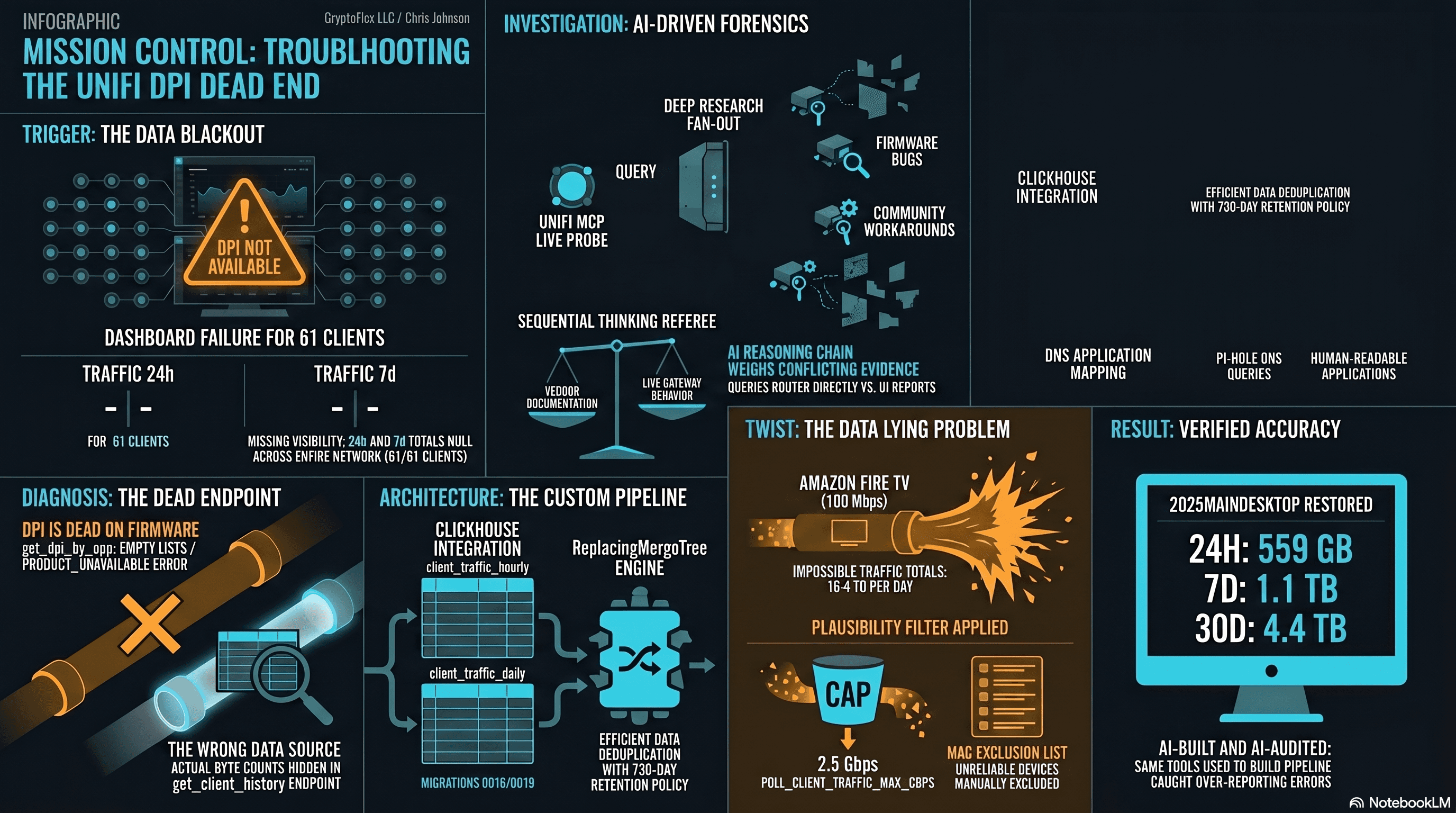
The Clients page showed "--" for traffic and "DPI not available for this device" for applications. The investigation found that per-app DPI is genuinely dead on this firmware, but per-client hourly byte buckets are alive and well in a different endpoint the dashboard was never reading. Fix the source, accumulate in ClickHouse, reconstruct Top Applications from Pi-hole DNS, and then discover that some clients are reporting physically impossible volumes. One afternoon, one commit (e07a8ac, 27 files), three confessional asides, and a plausibility cap that became load-bearing.
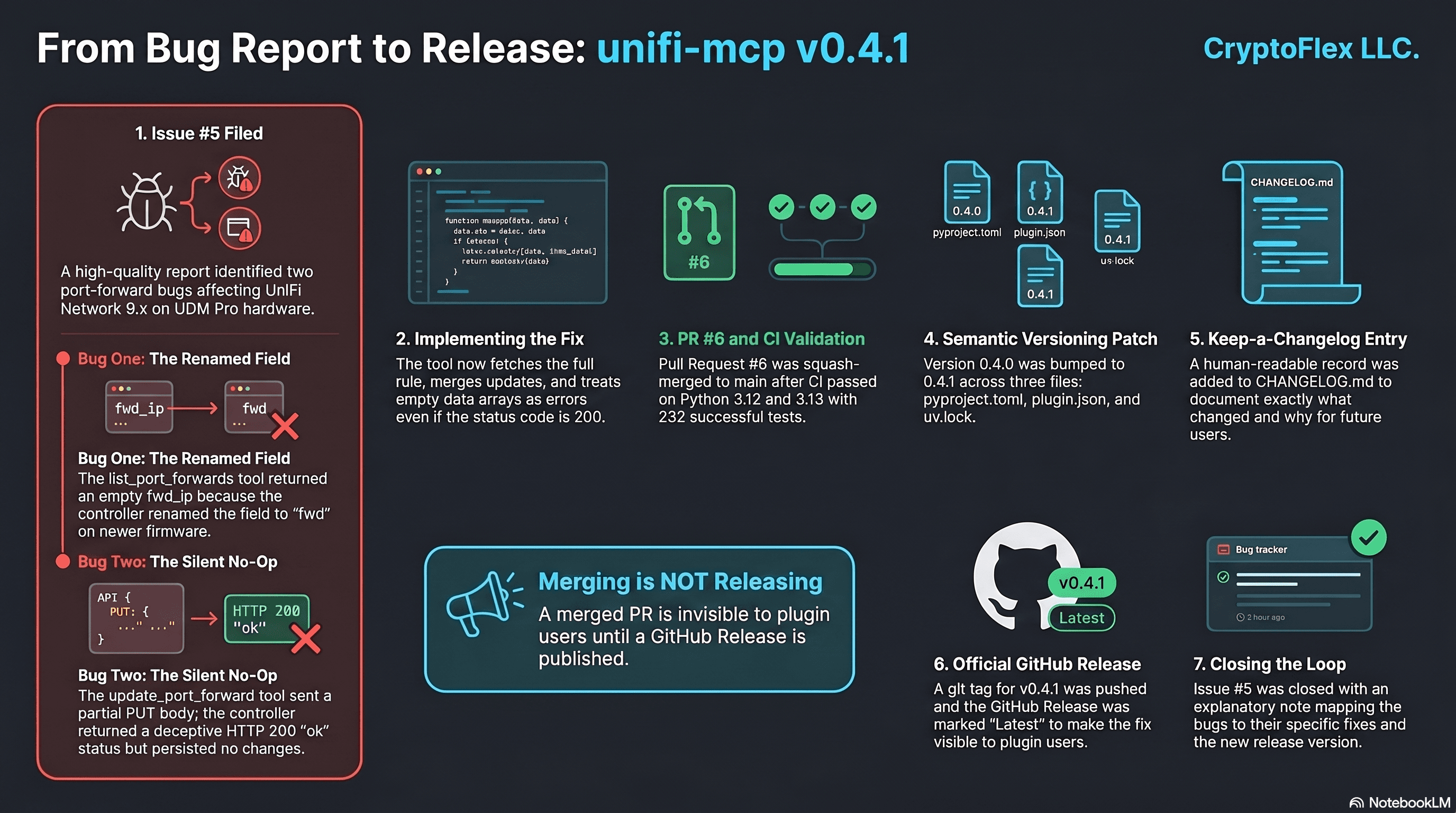
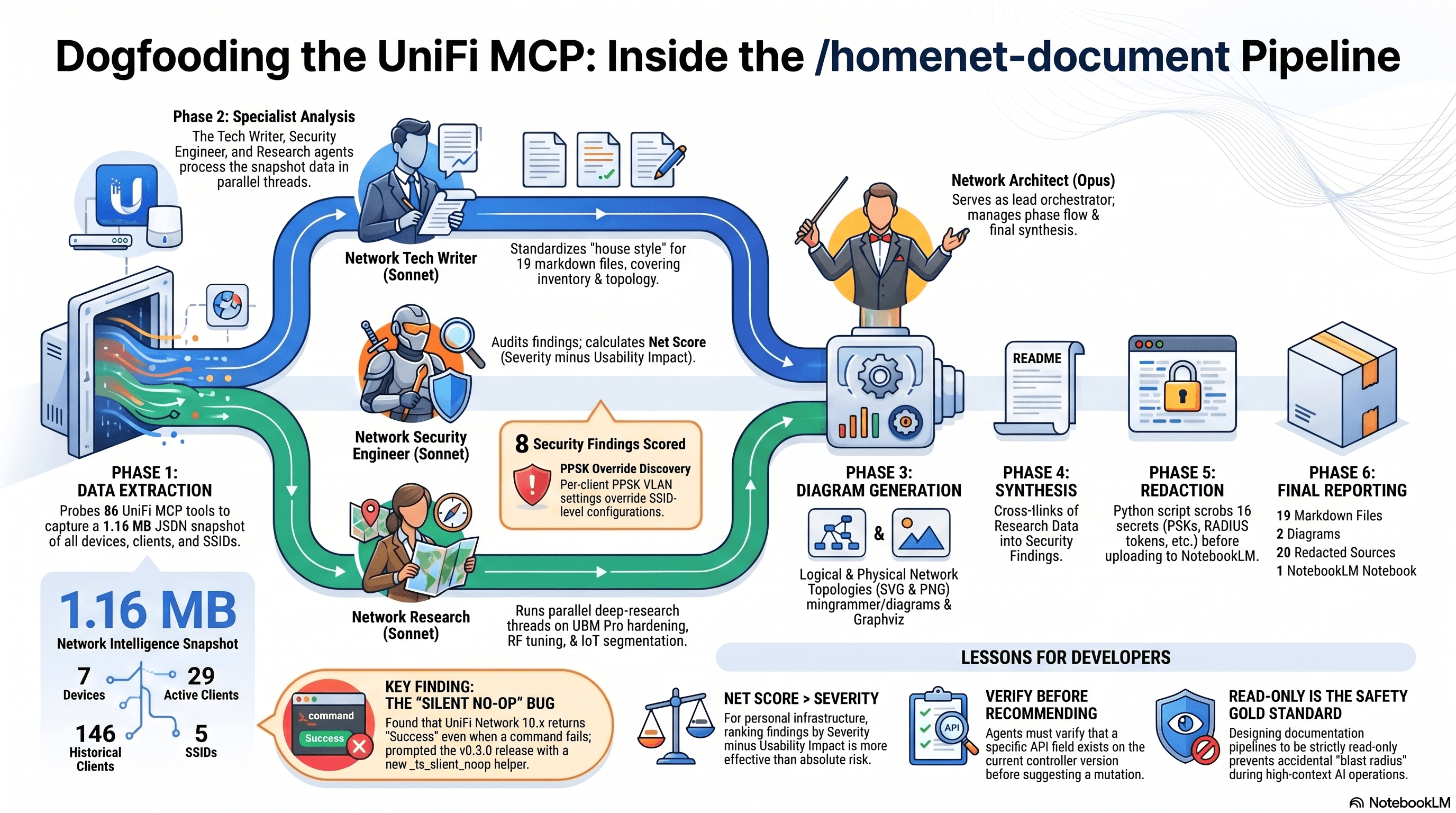
Someone filed issue #5 against my UniFi MCP: two port-forward bugs, one of them a silent no-op that reported success. Here is the whole journey from bug report to a published v0.4.1 release, and the open-source hygiene that makes a merge into something users can actually install.
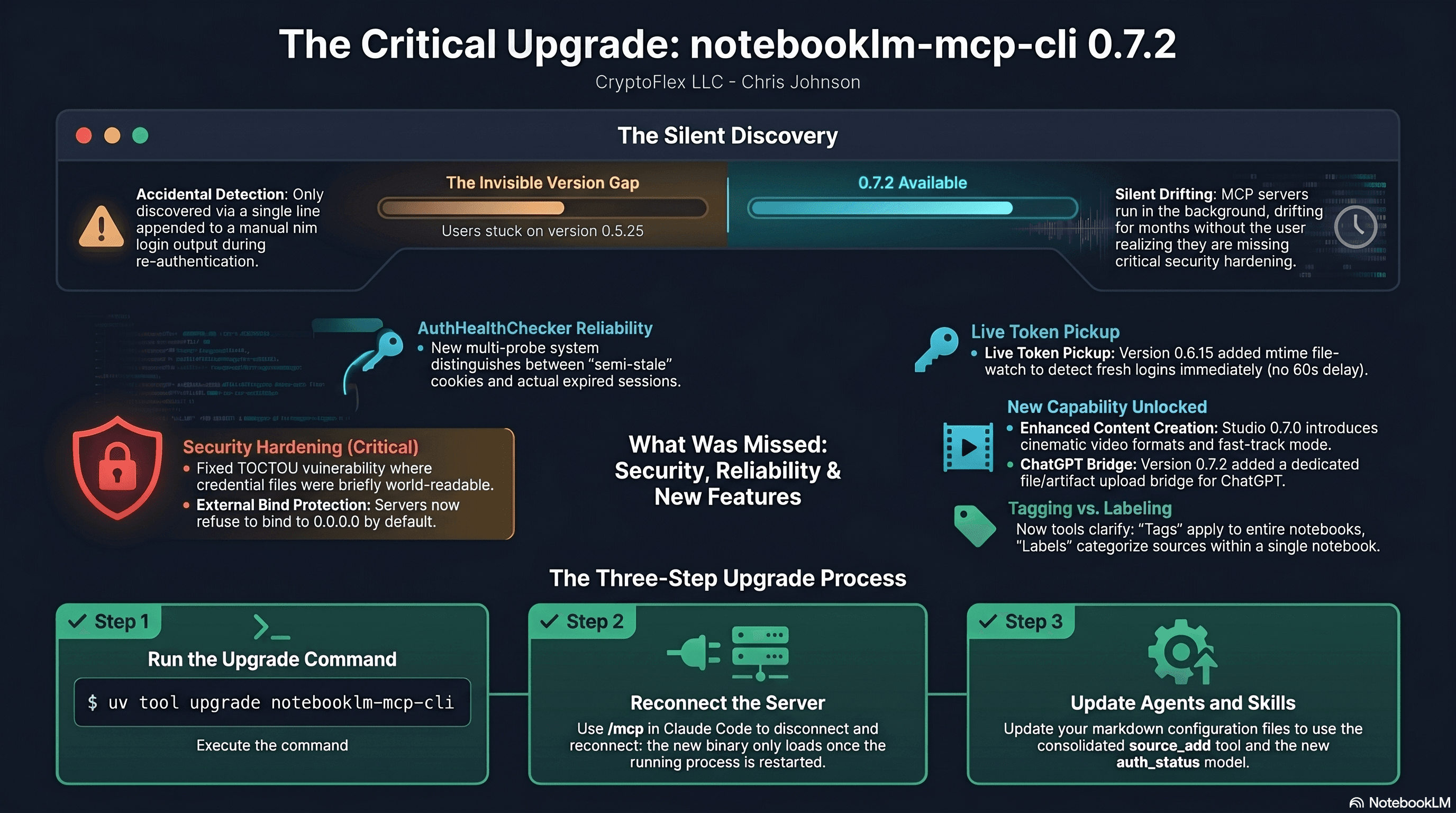
I was two minor versions behind on notebooklm-mcp-cli and had no idea until a re-auth banner interrupted a session. The gap was 0.5.25 to 0.7.2. Security fixes, auth reliability improvements, and new features I was missing the whole time. Here is the three-part upgrade that most people stop after step one.
A red dns_bypass card on my home dashboard sat at 0.667. Closing it took two ZBF rules, a deliberately incomplete remediation on the Default subnet, and a new traffic_rules surface in the chris2ao/unifi-mcp v0.4.0 release. Here is the full walk.
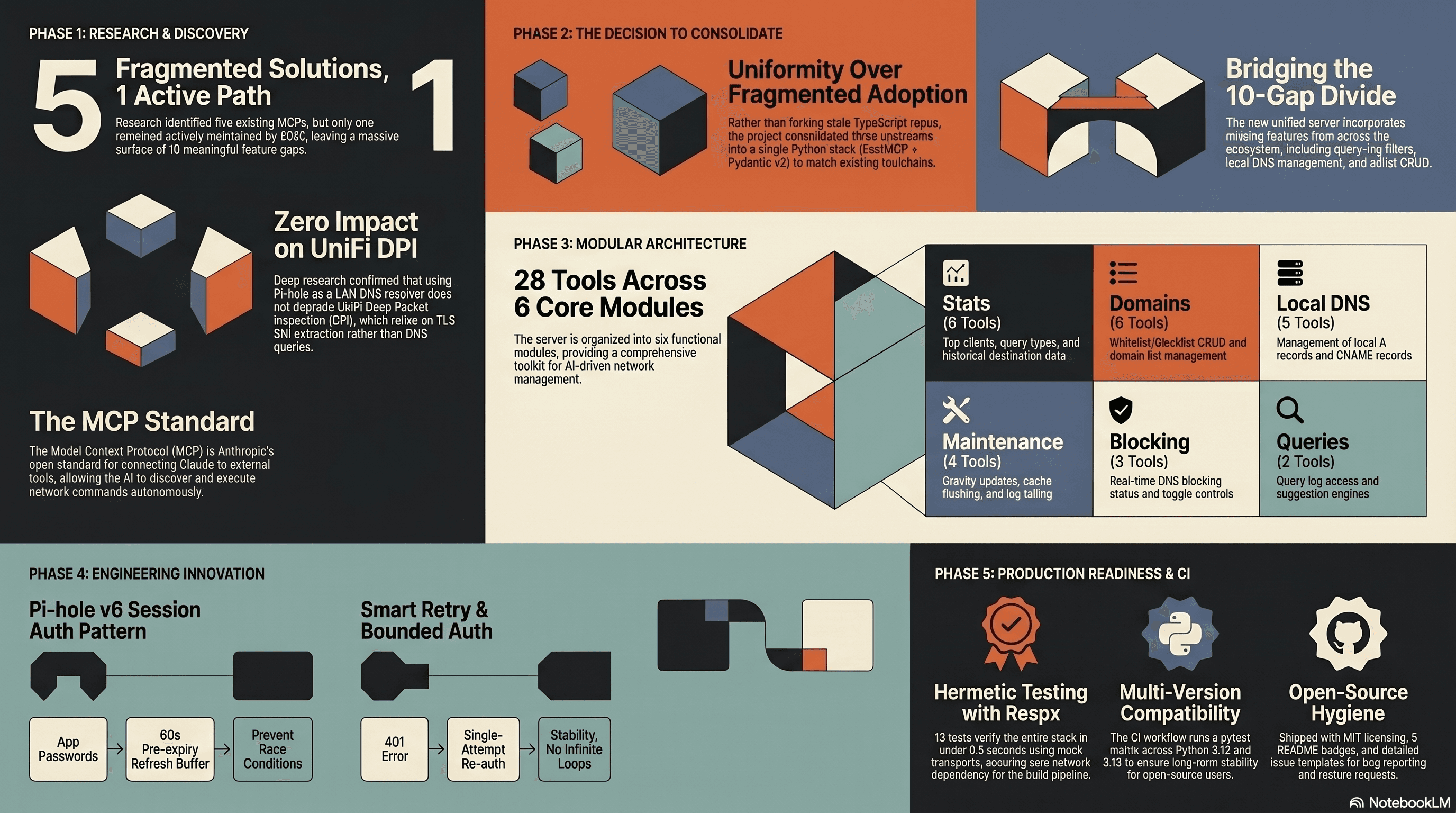
5 existing Pi-hole MCPs. 1 actively maintained. 10 real gap items. I used /deep-research to scan the landscape, then consolidated 28 tools from three upstream repos into one Python FastMCP server that matches my UniFi MCP stack, and shipped it public with CI, issue templates, and branch protection.
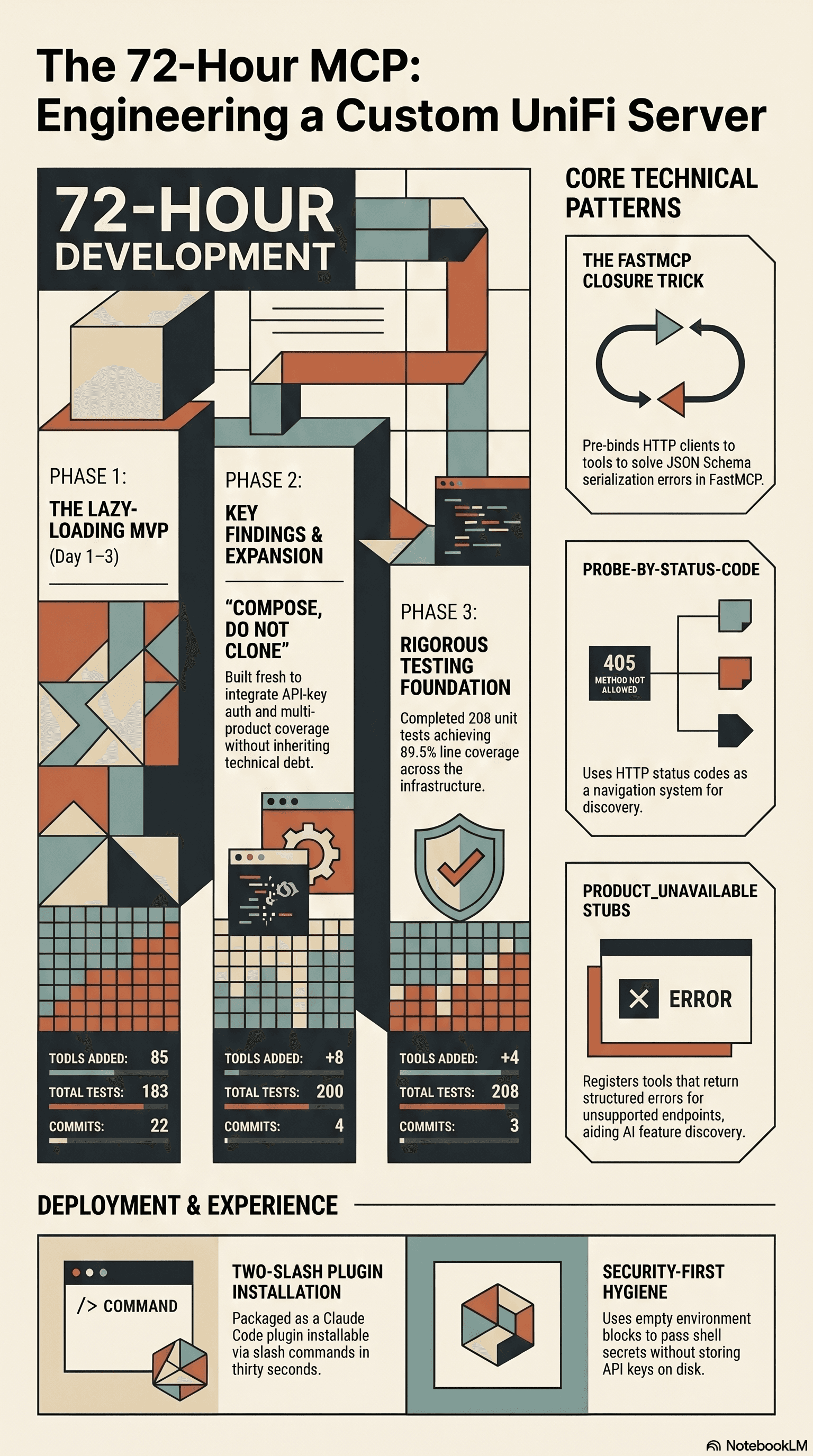
Two open-source UniFi MCP servers existed. Neither did what I wanted. So I built a third that combines their strengths, lazy-loads per product, and ships as a Claude Code plugin you can install with two slash commands.
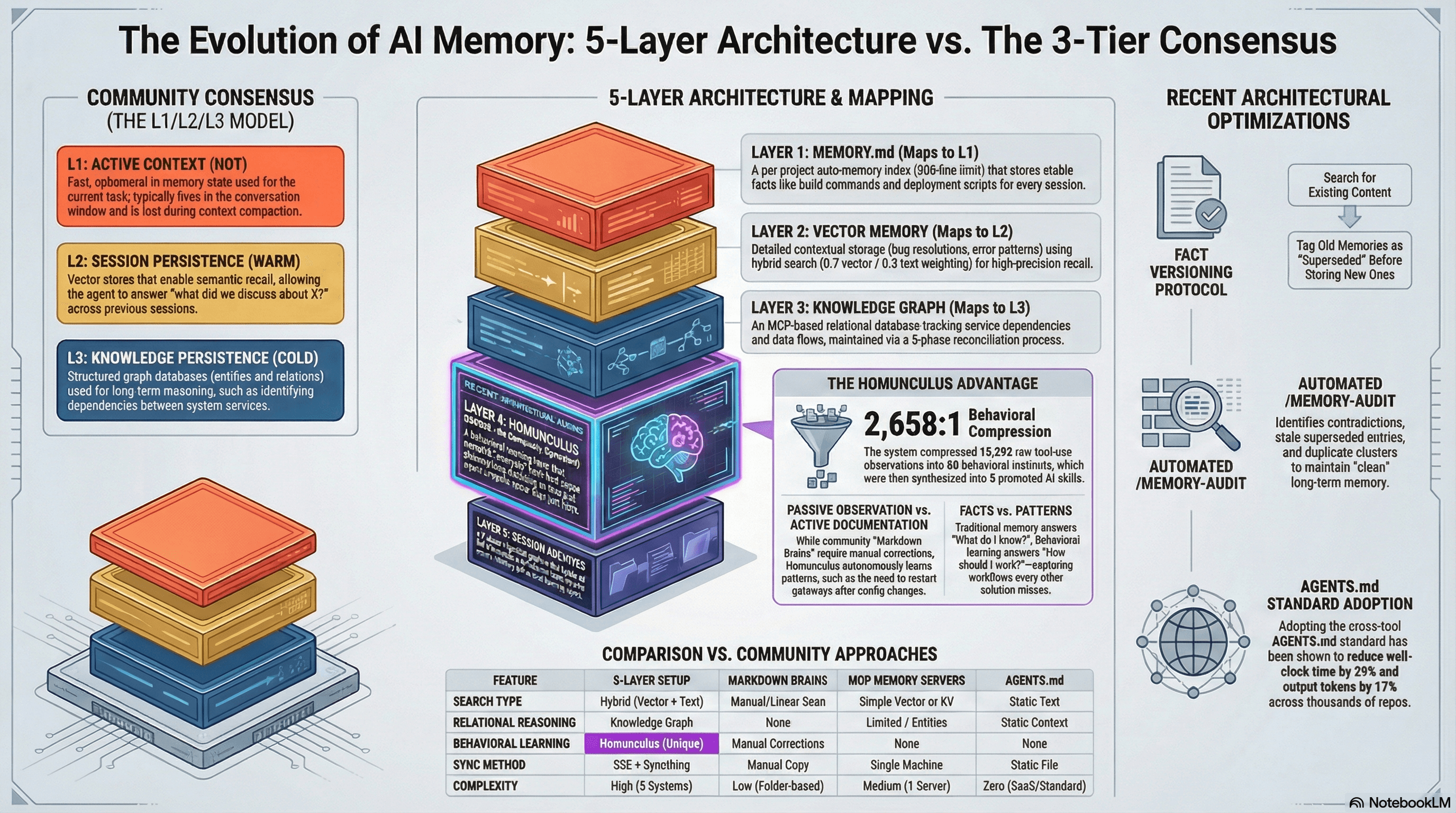
22 sources, 3 parallel research agents, 18 search queries. I pointed my deep research skill at the question every Claude Code power user asks: what's the best way to give an AI persistent memory? Here's what the community is doing, how my setup compares, and the 3 improvements I shipped the same day.
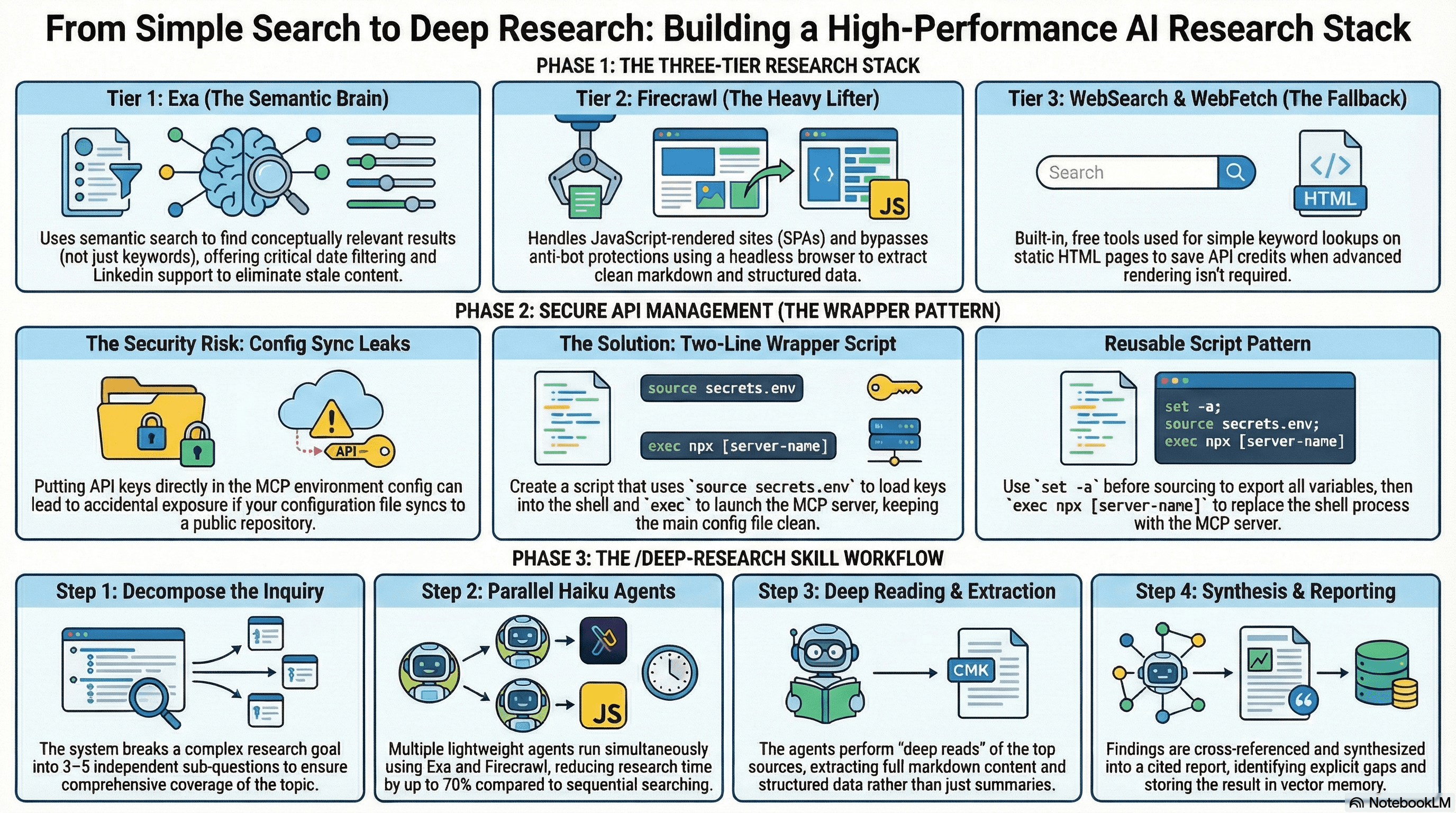
3 test sessions, 2 MCP servers, 1 wrapper script fix. How I added Exa and Firecrawl to Claude Code for semantic search, JS-rendered scraping, and proper deep research capability.
35 MCP tools, 7 implementation tasks, 2 platforms, 1 session. How I used the superpowers brainstorming, writing-plans, and subagent-driven-development pipeline to integrate NotebookLM into Claude Code as a first-class MCP server.
Claude Code's /compact command frees up context but destroys in-progress session state. Smart-compact is a custom skill that saves everything before you compact, so you can pick up exactly where you left off.
Three ways to run Claude Code remotely. I tried Dispatch, Channels, and Remote Control. Here's what broke, what worked, and why I landed on Remote Control with Warp terminal on my always-on Mac Mini.
How I replaced three separate Google Workspace MCP integrations with a single gws CLI skill, why CLI beats MCP for large API surfaces, and the four-tier safety system that keeps destructive operations from running without confirmation.
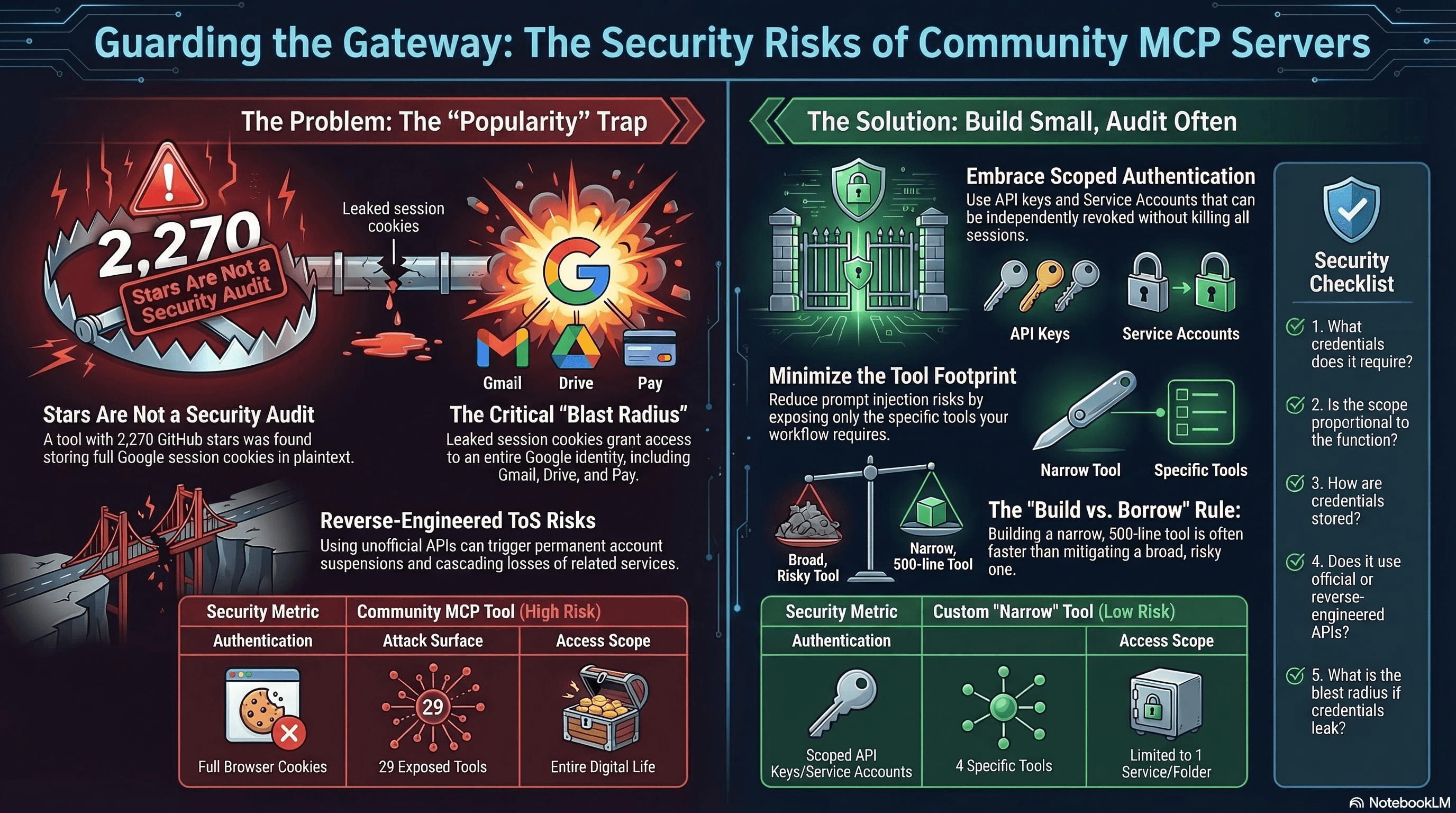
How a routine search for blog content tools led to discovering critical security risks in a popular MCP server, and why I built my own secure alternative.
A practical walkthrough of the 5 Node.js MCP servers I run with Claude Code: sequential-thinking, memory, context7, github, and project-tools. What they do, how to configure them on Windows, and what I learned testing each one.
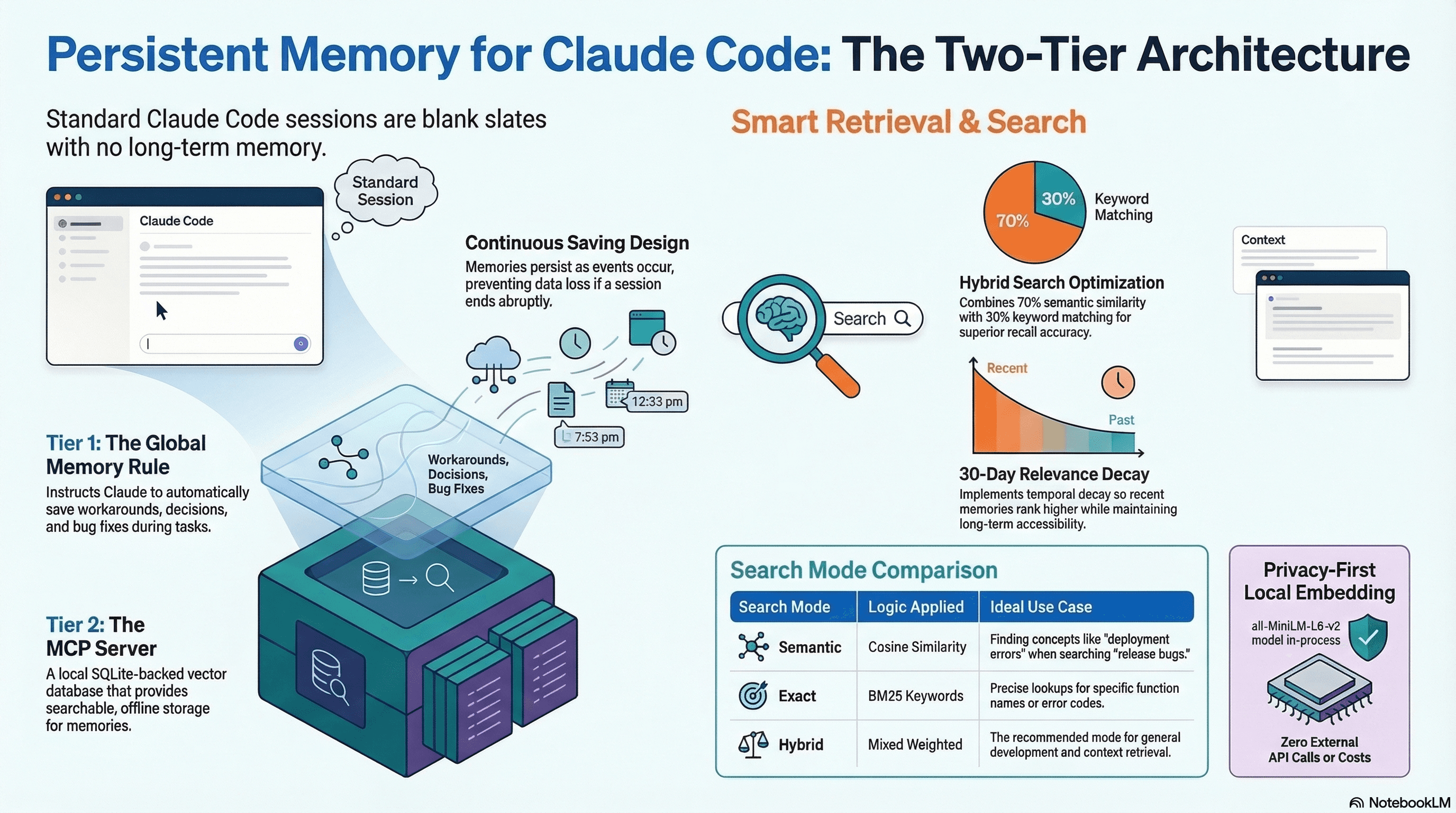
How to give Claude Code real persistent memory using a global rule file and a vector database MCP server, so context survives across sessions without any manual effort.
A deep dive into configuring Claude Code for real-world use - from modular rules and session logging hooks to MCP servers and the everything-claude-code plugin ecosystem.